


Mitsubishi Triton MR Rooftop Tent Guide: SAN HIMA Kalbarri Lite Gen 2
Can you put a rooftop tent on a Mitsubishi Triton MR? In many cases, a Triton MR can be considered for a rooftop tent when the exact vehicle configuration, roof-rack system, mounting hardware and rooftop tent are assessed together. The decision should not be based on the tent’s physical size or product weight alone.
This Australian guide explains the main Triton MR rooftop tent fitment checks, including vehicle configuration, dynamic and static roof load, rack selection, crossbar spacing, mounting rails, ladder clearance, final vehicle height and total rooftop equipment weight. It also uses the SAN HIMA Kalbarri Lite Gen 2 hard-shell rooftop tent as a current Australian-market product example.
Complete system: Mitsubishi Triton MR + roof rack or crossbars + mounting hardware + rooftop tent + occupants + camping equipment.
The Kalbarri Lite Gen 2 is not presented as universally compatible with every Mitsubishi Triton MR. It may suit a particular Triton MR depending on the vehicle documentation, rack or platform configuration, mounting-rail alignment and intended road conditions.
Can You Put a Rooftop Tent on a Mitsubishi Triton MR?
A Mitsubishi Triton MR can be considered for a rooftop tent when the exact vehicle, rack, mounting hardware and RTT meet the applicable requirements. The correct answer depends on the Triton’s body and drive configuration, the roof-rack system, the complete moving roof load and the way the ute will be used.
The MR Triton was sold in Australia in different body styles and grades, including Single Cab, Club Cab and Double Cab variants, with both 4x2 and 4x4 models available across the range. Mitsubishi’s Australian Triton material also distinguishes between pick-up and cab-chassis configurations. These differences matter because a rooftop-tent installation may use a cabin roof, a dedicated roof-rack system, a tub rack, a canopy system or another vehicle-specific mounting arrangement.
A photograph of a Triton MR carrying a rooftop tent can demonstrate that one particular vehicle has been equipped in one particular way. It does not prove that every MR Triton has the same roof structure, roof rating, rack compatibility or mounting layout. Owners should use the exact vehicle identification, owner information and rack instructions for their own ute.
The vehicle roof requirement and the rack rating are separate checks. A rack manufacturer may publish a rating for a specific rack, bar spread or platform configuration, but that rating does not automatically increase the vehicle manufacturer’s limit. If a vehicle or rack document is unclear, the appropriate conclusion is that the setup requires confirmation from Mitsubishi Motors Australia, the rack manufacturer or a qualified installer before purchase or installation.

What Should You Check Before Installing a Rooftop Tent on a Triton MR?
Before installing a Triton MR rooftop tent, verify the vehicle configuration, vehicle roof requirements, rack rating, tent rail spacing, mounting hardware, clearance and complete moving load. These checks should be completed as one fitment assessment rather than as separate assumptions.
1. Confirm the exact Triton MR configuration
Start with the vehicle’s model year, body style, drive system and roof arrangement. A Double Cab pick-up, Club Cab, Single Cab, cab-chassis, canopy and tub-rack conversion may all involve different mounting considerations.
Do not use a roof-load figure found for a different Triton generation, overseas market or unrelated body style. The term “MR Triton” identifies a model generation, but it does not by itself identify every equipment level or roof-rack arrangement.
2. Check the vehicle roof requirements
Use the owner documentation applicable to the exact Triton MR. The relevant vehicle guidance should take priority over general forum advice, a product-page comment or a rating quoted for another vehicle.
No universal Australian roof-load figure should be applied to every Mitsubishi Triton MR without confirming the exact source and configuration. If the applicable Mitsubishi documentation does not clearly describe rooftop-tent use or the required roof loading, ask Mitsubishi or an authorised representative for clarification.
3. Understand dynamic roof load
Dynamic roof load is the load carried while the Triton is moving. For a rooftop-tent system, this can include the RTT, rack, crossbars, mounting plates, brackets and other equipment that remains attached during travel.
The calculation is not simply the weight of the tent. Use the following planning formula:
For the current SAN HIMA Kalbarri Lite Gen 2 listing, the product is stated as 60.5 kg with the ladder removed and 65.5 kg with the ladder attached. Those are product weights. They are not an approval for a Triton MR and they do not include the rack, brackets or other attached equipment.
4. Understand static roof load
Static roof load is the load supported while the vehicle is stationary. Depending on the vehicle, rack and RTT instructions, the stationary load may include the open tent, rack system, bedding and occupants.
Static capacity must not be used as permission to exceed the dynamic driving limit. A system that supports occupants while parked may still be unsuitable for driving if the moving load is above the applicable vehicle or rack limit.
5. Check the rack or platform rating
Choose a rack or platform designed for the exact Triton MR configuration and intended for rooftop-tent use. Confirm the manufacturer’s instructions for:
- Vehicle model and model-year coverage
- Cab and roof configuration
- Rack or platform weight
- Dynamic rating
- Static rating, where published
- Off-road restrictions or speed limits
- Approved mounting points
- Bar spread or platform support areas
- Compatibility with the RTT mounting hardware
Roof-rack manufacturers such as Rhino-Rack and Yakima provide vehicle-selection tools for Mitsubishi Triton applications. These tools are useful for narrowing down possible systems, but the final selection still depends on the exact product instructions and the complete installation.
6. Measure crossbar spacing and RTT mounting rails
The distance between the Triton rack bars must be compared with the rooftop tent’s approved mounting layout. The current Australian SAN HIMA Kalbarri Lite Gen 2 listing gives a mounting-rail spacing of 70 cm.
That measurement is an input for fitment, not proof that every Triton MR rack will align. Measure the actual bar or platform locations and check whether the support points remain within the approved areas. Do not drill the tent, move mounting points outside the instructions or create improvised spacers simply to make a layout appear to fit.
7. Confirm mounting hardware compatibility
The mounting hardware must match the RTT rails and the rack, crossbar, platform channel or backbone system. Before tightening anything, check fastener access, plate position, channel dimensions and the manufacturer’s installation sequence.
A plate that looks universal may not be suitable for every rack profile. If the hardware cannot be installed in the intended position, pause the installation and request a supported solution from SAN HIMA or the rack manufacturer.
8. Check ladder and surrounding clearance
When the tent is open, check the ladder position against the ute’s doors, tray, canopy, awning, steps and the ground surface. The current Kalbarri Lite Gen 2 listing gives a telescopic ladder length of 2.3 m when fully extended and a ladder capacity of 150 kg.
Those product specifications do not predict the ladder angle or ground contact on every Triton. A sloping campsite, a raised suspension setup, a tub rack or a nearby awning may change the usable ladder position.
9. Measure the completed vehicle height
The final vehicle height includes the Triton, rack or platform, mounting hardware, closed rooftop tent and any other roof-mounted accessories. Measure the finished vehicle at its highest point rather than adding approximate component heights.
The Kalbarri Lite Gen 2 is listed at 11.6 cm when folded. This is the product’s folded thickness, not the completed Triton’s height. Measure the full setup for garages, car parks, service stations, low branches, ferry access and storage.
10. Consider the total vehicle payload
The roof-mounted system is only one part of the Triton’s total payload. Also account for passengers, fuel, water, recovery equipment, tools, food, batteries, luggage, canopies and tray or tub accessories.
A lightweight RTT can reduce the tent’s contribution to the roof system, but it does not remove the need to check the vehicle’s total mass, axle loads or other manufacturer requirements.

What Makes a Rooftop Tent Suitable for a Mitsubishi Triton MR?
A suitable Triton MR rooftop tent balances weight, mounting compatibility, packed height, sleeping space, clearance and the way the ute will be used. Product features should be assessed only after the vehicle and rack requirements have been established.
RTT weight
The tent is often one of the largest single items added to the roof. A lower product weight may leave more capacity for the rack, mounting hardware and other attached equipment, but it does not create a new vehicle rating.
Weight also affects handling. A rooftop tent places mass above the vehicle, which can influence the centre of gravity, wind exposure and the way the Triton feels on corrugations, bends and uneven tracks. The result depends on the complete roof system and the loaded vehicle.
Low-profile design
A low-profile RTT may help with everyday parking, storage and wind planning. It can also make the finished ute less visually bulky when the tent is closed. However, the tent’s thickness is only one part of the final height; rack legs, platform, mounting hardware and accessories still need to be measured.
Hard-shell construction
A hard-shell RTT can provide a contained packed shape and a repeatable open-and-close routine. Hinges, shell panels, base components, rails and gas-assist hardware all contribute to the product’s construction and weight. After rough travel, inspect the shell, base, mounting rails and fasteners for movement, rubbing or damage.
Sleeping space and exterior footprint
Compare internal dimensions rather than relying only on the outer footprint. The current Kalbarri Lite Gen 2 listing gives internal dimensions of 207 × 117 × 144 cm and a self-inflating mattress measuring 191 × 115.5 × 6 cm.
That information helps an owner compare sleeping space with the number of occupants, bedding and storage requirements. It does not establish whether the tent fits a particular rack or Triton.
Setup and pack-up convenience
A rooftop tent is most useful when it suits the owner’s camping routine. Weekend campers may prioritise quick setup and easy pack-up. Touring users may place more emphasis on weather protection, storage and daily driving. A Triton used as a work vehicle during the week may need a system that can remain installed without creating unacceptable height or clearance problems.
Weather protection
Waterproofing, fabric, ventilation, rainfly design and shell construction are useful comparison points. They are not guarantees for every Australian storm, installation condition or campsite. The product’s published specifications should be read alongside correct setup, drying and maintenance instructions.
SAN HIMA Kalbarri Lite Gen 2 for Mitsubishi Triton MR
The SAN HIMA Kalbarri Lite Gen 2 is a hard-shell rooftop tent listed for the Australian market. A Triton MR owner may consider it when lower RTT weight, low folded height and a compact hard-shell camping routine are priorities.
The current Australian SAN HIMA product page lists the following specifications. These describe the RTT itself; they do not confirm universal Mitsubishi Triton compatibility.
| Specification | SAN HIMA Kalbarri Lite Gen 2 |
|---|---|
| Product type | Hard-shell rooftop tent |
| Weight without ladder | 60.5 kg |
| Weight with ladder | 65.5 kg |
| Folded dimensions | 212 × 131 × 11.6 cm |
| Unfolded dimensions | 212 × 131 × 156 cm |
| Internal dimensions | 207 × 117 × 144 cm |
| Mattress | Self-inflating mattress, 191 × 115.5 × 6 cm |
| Mounting-rail spacing | 70 cm |
| Waterproof rating | PU 5,000 mm |
| UV protection | 50+ as listed; the product description also refers to UPF 50+ protection |
| Shell / base construction | Hard-shell RTT; aluminium honeycomb panel and aluminium base frame listed. The current specification block does not identify a separate shell material. |
| Fabric | 420D double-ripstop Oxford fabric and 280G polyester-cotton |
| Ladder | Aluminium telescopic ladder; 2.3 m fully extended; 150 kg capacity |
| Other listed features | Automatic pop-up rainfly, digital control panel, built-in AC duct opening, self-inflating mattress and full-ceiling LED strip light |
The product page also lists a 12V/15A maximum CIG socket and several USB charging outputs. These are product features rather than vehicle fitment specifications. Any electrical installation or accessory use should follow the supplied product instructions and the owner’s broader vehicle setup requirements.
Why a Lightweight, Low-Profile RTT May Suit a Triton MR
Lightweight design
At 60.5 kg without the ladder, the Kalbarri Lite Gen 2 gives a Triton owner a clearly defined tent weight to place into the moving-load calculation. The 65.5 kg figure includes the ladder. The rack, crossbars, mounting kit and other attached equipment must then be added.
This can be useful when comparing different rack systems or planning a ute that already carries a canopy, awning, solar equipment or other touring accessories. It should not be described as a safety margin until the exact vehicle and rack requirements have been confirmed.
Low-profile folded height
The listed folded height is 11.6 cm. For a Triton MR, a lower packed profile may make the completed setup easier to manage in low-clearance areas and may reduce the visual bulk of the vehicle. The practical outcome depends on the rack height and the position of other roof accessories.
Always measure the completed Triton. Do not use the tent’s 11.6 cm figure as the final vehicle-height measurement.
Hard-shell setup and pack-up
The hard-shell format and automatic pop-up rainfly are relevant to owners who make frequent stops or want a consistent setup routine. The product listing describes a quick-opening design, but actual setup time depends on weather, bedding, ladder position, rack access and how the tent has been packed.
The tent should be packed dry and maintained according to the supplied instructions. A hard shell does not remove the need to inspect the mounting system after corrugated or uneven-road travel.
Sleeping space
The 207 × 117 × 144 cm internal dimensions and 191 × 115.5 × 6 cm self-inflating mattress provide concrete dimensions for planning. Owners should compare those measurements with the number of occupants and the bedding they intend to carry.
The external 212 × 131 cm folded footprint also needs to be checked against the Triton rack, platform, canopy, antenna, light bars and other accessories. A physical footprint that appears manageable may still create a rail, clearance or access problem.

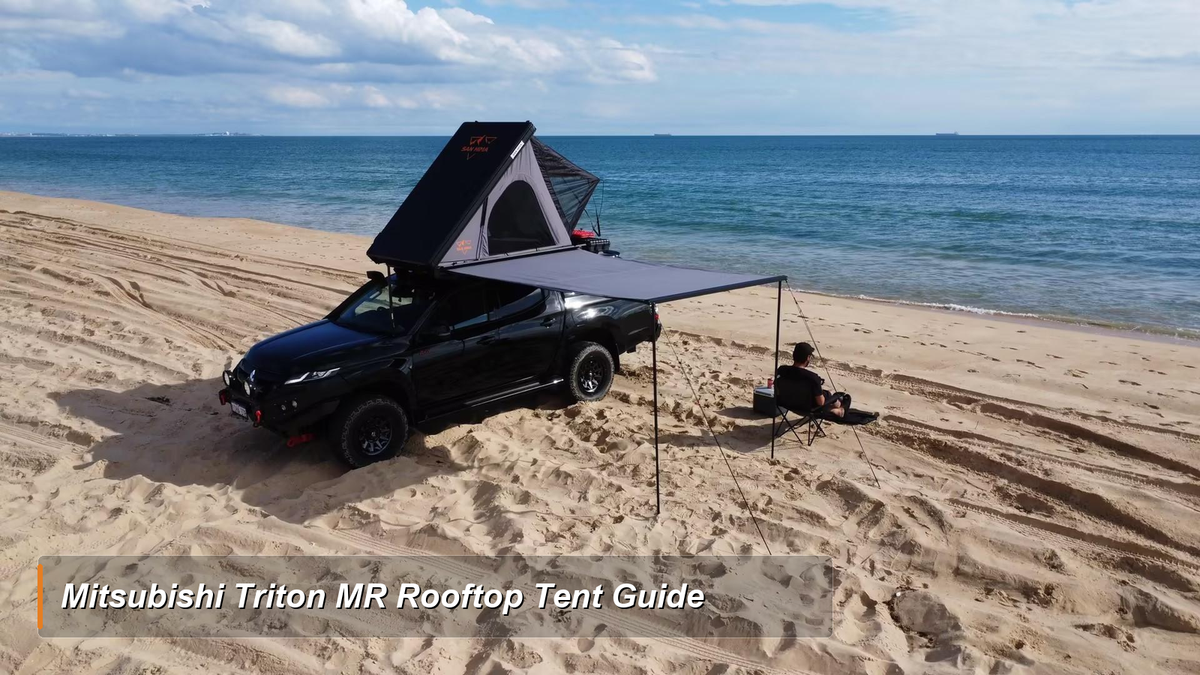
Mitsubishi Triton MR + SAN HIMA Kalbarri Lite Gen 2: Real-World Setup
A real-world Triton MR carrying the SAN HIMA Kalbarri Lite Gen 2 is useful as a visual example of how a lightweight hard-shell RTT can be integrated into a ute-based camping system. The vehicle photographs should be treated as photographic evidence of that particular installation only.
When the images are added, readers should be able to see the relationship between the Triton’s roof area, the RTT’s closed profile and the overall vehicle shape. A closed-tent image is especially useful for showing how the tent sits above the vehicle. An open-tent image can show the unfolded sleeping area and the ladder position if those details are visible. A side or three-quarter view can help readers understand the visual profile, but it cannot confirm the rack’s dynamic rating or the vehicle’s roof allowance.
This Triton MR and SAN HIMA Kalbarri Lite Gen 2 combination is one real-world example, not a universal fitment approval for all Triton MR vehicles.
The most useful visual checks are practical rather than promotional:
- Where the RTT sits relative to the vehicle roof and rack
- Whether the closed tent remains clear of visible vehicle components
- How the ladder is positioned when the tent is open
- Whether the open tent has space around doors, awnings and campsite equipment
- How the low-profile tent changes the vehicle’s overall appearance
- Whether the setup appears suited to touring, weekend camping or a specific outdoor environment shown in the image
Technical claims must still come from the vehicle, rack and RTT documentation. Photographs cannot prove the exact load rating, fastener torque, rail spacing or universal compatibility.
Mitsubishi Triton MR Rooftop Tent Setup Considerations
A safe installation should follow the vehicle, rack and RTT manufacturers’ instructions. The following sequence is a planning framework, not a replacement for the supplied installation manual.
- Identify the exact Triton MR. Record the model year, cab style, drive system, roof arrangement and any canopy or conversion.
- Confirm vehicle requirements. Use the applicable Mitsubishi information and ask for clarification if rooftop loading is not clearly addressed.
- Select the rack or platform. Confirm that it is designed for the Triton configuration and intended for the proposed RTT use.
- Check the rack instructions. Review dynamic, static and off-road guidance where those ratings are published.
- Measure the rack layout. Confirm the actual bar spread or platform support positions.
- Compare the RTT rails. The Kalbarri Lite Gen 2 lists 70 cm mounting-rail spacing; check that the chosen rack can support the tent within approved locations.
- Confirm the hardware. Use the supplied or approved mounting system and follow the specified installation sequence.
- Position the RTT. Check roof support, rear access, canopy clearance, antenna clearance and accessory locations.
- Check the ladder. Open the tent in a safe area and confirm stable ground contact and clearance from the ute and surrounding equipment.
- Measure the final height. Record the highest point of the completed Triton and RTT system.
- Calculate the moving load. Include the RTT, ladder, rack, brackets and other attached equipment.
- Inspect before driving. Check fasteners, movement, rubbing and unusual noise, then recheck the installation after the first short drive.
If the rail spacing or hardware does not align, do not modify the RTT or improvise a mounting solution without manufacturer approval.
Triton MR Rooftop Tent Camping Scenarios
Weekend camping
A hard-shell RTT can suit Triton owners who want to leave the ute’s cabin and tub available for camping equipment. The Kalbarri Lite Gen 2’s lower listed weight and low folded profile may be relevant to owners balancing roof loading with a rack, awning and other gear.
Long-distance touring
Touring places more emphasis on repeatable setup, weather management, packed height, storage and access to fuel, food and recovery equipment. The tent should be checked regularly during a long trip, particularly after corrugations and rough unsealed roads.
4WD trips and overlanding
A Triton MR used for 4WD travel may carry water, recovery boards, tools, spare parts, fuel and communication equipment. Those items remain part of the complete vehicle and payload assessment. The RTT’s off-road suitability also depends on the rack system, mounting security, road speed and terrain.
Remote camping
Remote travel makes inspection and conservative loading more important. A loose fastener, damaged rail or overloaded rack may be harder to resolve away from town. Carry out a pre-trip inspection and follow the rack and tent manufacturers’ maintenance guidance.
Everyday vehicle plus weekend camping
A lower-profile RTT can be relevant to owners who use the Triton during the week and camp on weekends. The key questions are whether the vehicle remains within everyday height limits, whether the tent can stay installed, and whether the complete roof system changes parking or work-site access.

Mitsubishi Triton MR Rooftop Tent Fitment Checklist
- ☐ Exact Triton MR model year and configuration confirmed
- ☐ Cab style and 4x2 or 4x4 configuration confirmed
- ☐ Vehicle roof-load requirements checked with Mitsubishi documentation
- ☐ Roof-rack or platform model confirmed
- ☐ Rack dynamic rating checked
- ☐ Rack static rating checked where published
- ☐ Off-road rating or restrictions checked where applicable
- ☐ Complete moving roof load calculated
- ☐ Crossbar or platform support positions measured
- ☐ Kalbarri Lite Gen 2 70 cm rail spacing checked against the rack
- ☐ Mounting hardware confirmed for both the RTT and rack
- ☐ Ladder clearance checked
- ☐ Rear door, canopy, awning and antenna clearance checked
- ☐ Completed vehicle height measured
- ☐ Occupants, fuel, water, recovery gear and camping equipment considered
- ☐ Mounting hardware rechecked before driving and after the first short trip
- ☐ Any unresolved specification referred to Mitsubishi or the rack manufacturer
- ☐ Final installation reviewed against the supplied RTT instructions
If a checklist item cannot be confirmed, treat it as unresolved rather than substituting a generic Triton claim. A complete checklist is useful because rooftop-tent fitment depends on several connected parts rather than one product number.
Frequently Asked Questions
Can you put a rooftop tent on a Mitsubishi Triton MR?
A Triton MR can be considered for a rooftop tent when the exact vehicle, rack, hardware and RTT are compatible. Confirm the vehicle requirements, rack ratings, rail alignment, complete moving load and clearance before installation.
What rooftop tent fits a Mitsubishi Triton MR?
The suitable RTT is the one whose weight, dimensions, mounting rails and hardware match the exact Triton MR rack and vehicle configuration. No single tent can be declared compatible with every MR Triton without checking the complete system.
Is the SAN HIMA Kalbarri Lite Gen 2 suitable for a Triton MR?
It may suit a Triton MR depending on the vehicle configuration and rack setup. The current Australian listing gives 70 cm mounting-rail spacing, so the selected rack must support that layout and the complete vehicle system must meet the relevant requirements.
How much does the SAN HIMA Kalbarri Lite Gen 2 weigh?
The current Australian SAN HIMA listing gives 60.5 kg without the ladder and 65.5 kg with the ladder attached. Add the rack, mounting hardware and other attached roof equipment before assessing the moving load.
How tall is the Kalbarri Lite Gen 2 when folded?
The current Australian listing gives a folded height of 11.6 cm. That is the tent’s folded thickness, not the final height of a Triton MR with its rack and accessories fitted.
What roof rack do I need for a Triton rooftop tent?
You need a rack or platform designed for the exact Triton MR configuration and suitable for rooftop-tent mounting. Check vehicle coverage, dynamic and static ratings, off-road guidance, bar spread, platform support and hardware compatibility.
What should I check before installing an RTT on a Triton MR?
Check the vehicle configuration, vehicle roof requirements, rack ratings, complete moving load, rail spacing, hardware, ladder clearance and final vehicle height. These checks must be made together.
What is dynamic roof load?
Dynamic roof load is the load carried while the Triton is moving. It may include the RTT, ladder, rack, crossbars, mounting plates, brackets and other attached equipment.
What is static roof load?
Static roof load is the load supported while the vehicle is stationary. It may include the open RTT, rack, bedding and occupants depending on the applicable instructions, but it must not replace the dynamic driving limit.
Is a hard-shell rooftop tent practical for a Triton?
A hard-shell RTT can be practical when its weight, height, mounting system and clearance suit the Triton MR setup. It may provide a contained packed shape and a repeatable setup routine, but the rack and vehicle checks remain essential.
Is a lightweight rooftop tent useful for a Triton?
A lightweight RTT can reduce the tent’s contribution to the moving roof load. It does not change the vehicle or rack rating, and it must still be assessed with the rack, hardware, occupants and camping equipment.
How do I check rooftop tent compatibility with my Triton MR?
Compare the exact Triton documentation, rack instructions and RTT mounting requirements. Confirm the 70 cm Kalbarri Lite Gen 2 rail spacing, complete load, clearance and final height, and ask the manufacturers when any detail is unclear.
Conclusion
A Mitsubishi Triton MR rooftop tent installation should be planned as a complete vehicle system rather than a product purchase. Start with the exact Triton configuration and applicable Mitsubishi information. Then confirm the rack or platform, dynamic and static guidance, mounting hardware, RTT rail spacing, ladder position, final height and complete moving load.
The SAN HIMA Kalbarri Lite Gen 2 is one current Australian hard-shell RTT option to consider. Its listed 60.5 kg weight without the ladder, 65.5 kg weight with the ladder, 11.6 cm folded height, 70 cm mounting-rail spacing and 207 × 117 × 144 cm internal dimensions give owners practical specifications for comparison. They do not establish automatic compatibility with every Triton MR.
The right result depends on the complete combination of Mitsubishi Triton MR + rack or crossbars + mounting hardware + rooftop tent + occupants + camping equipment. When those elements are checked against the manufacturers’ instructions, the Triton can be assessed more responsibly for Australian weekend camping, touring and 4WD travel.

Leave a comment
This site is protected by hCaptcha and the hCaptcha Privacy Policy and Terms of Service apply.