


Isuzu D-MAX Rooftop Tent Guide: SAN HIMA Kalbarri Gen 2
Can you put a rooftop tent on an Isuzu D-MAX? In most cases, an Isuzu D-MAX can be considered for a rooftop tent when the specific vehicle body style, roof-rack system, mounting hardware and rooftop tent are evaluated together as a unified system. Fitment is not a simple question of whether the tent physically fits on the roof or what the tent weighs out of the box.
This Australian guide explains the critical fitment checks for the Isuzu D-MAX, including vehicle body styles, cabin versus canopy and tub-rack mounting, dynamic versus static roof loads, rack selection, crossbar spacing, mounting rails, ladder positioning, vehicle height and total payload planning. It also examines the SAN HIMA Kalbarri Gen 2 Hard Shell Rooftop Tent as a current Australian-market product example.
Complete system: Isuzu D-MAX + roof rack or tub rack or canopy frame + mounting hardware + rooftop tent + occupants + camping equipment.
The Kalbarri Gen 2 is not presented as universally compatible with every Isuzu D-MAX on the road. Depending on whether your D-MAX is a Crew Cab, Space Cab or Single Cab, whether it has factory roof rails or a bare roof, and whether you mount the tent over the cabin, on a tub rack or atop a reinforced canopy, the Kalbarri Gen 2 may suit specific touring and camping setups when configured correctly.
Can You Put a Rooftop Tent on an Isuzu D-MAX?
Yes, an Isuzu D-MAX can be considered for a rooftop tent when the specific vehicle variant, roof rack or mounting frame, mounting hardware and rooftop tent satisfy all relevant load and structural requirements. Compatibility depends on the exact cab style, mounting location (cabin, tub rack or canopy), complete moving load and intended driving conditions.
The Isuzu D-MAX is one of Australia’s most popular 4WD utes for good reason. Across Australian model generations—notably the second generation (RT50/RT85, 2012–2020) and the current third generation (RG01, 2020–present)—the D-MAX has been sold in multiple body styles:
- Crew Cab (Dual Cab): The most common touring setup, featuring four full doors and a cabin roof long enough to support multi-bar rack systems or platforms.
- Space Cab (Extra Cab): A two-door cabin with rear suicide doors and a longer rear tub/tray, offering a shorter cabin roofline but greater rear tub deck length.
- Single Cab: A dedicated two-door workhorse cabin, typically paired with a full-length aluminium tray or service body.
- Pick-up (Tub body) vs Cab-Chassis (Tray body): The rear cargo configuration dictates whether secondary mounting options—such as tub racks, bed bars, canopies or service canopy frames—are available.
Because the D-MAX offers diverse cabin lengths and rear tub setups, rooftop tents are rarely installed in just one way. An owner might mount an RTT over the cabin roof using heavy-duty crossbars or a flat platform, over the rear tub using a steel/aluminium tub rack, or over a canopy fitted with internal load-bearing bracing.
A photograph of an Isuzu D-MAX with a rooftop tent demonstrates that a specific vehicle was fitted with a specific rack and tent combination. It does not prove that every D-MAX variant has identical roof strength, mounting points or rack compatibility. Compatibility must always be assessed through the complete load chain:
Vehicle roof ratings and aftermarket rack ratings are completely separate specifications. A heavy-duty roof platform might have a high product rating, but that rating cannot exceed the vehicle manufacturer’s engineered roof allowance. If documentation for your exact vehicle or rack setup is unclear, verify compatibility with Isuzu UTE Australia, your roof-rack manufacturer or a certified 4WD installer before purchasing or fitting an RTT.

What Should You Check Before Installing a Rooftop Tent on a D-MAX?
Before installing a rooftop tent on an Isuzu D-MAX, verify the exact vehicle configuration, vehicle roof requirements, roof-rack rating, dynamic and static loads, crossbar spacing, RTT mounting rail alignment, mounting hardware, ladder clearance, overall vehicle height and total payload. These checks must be evaluated together rather than treated as isolated assumptions.
1. Confirm the exact D-MAX variant
Start with the vehicle’s model year, body style, drive system and roof arrangement. A Double Cab pick-up, Space Cab, Single Cab, cab-chassis, canopy and tub-rack conversion may all involve different mounting considerations.
Do not use a roof-load figure found for a different ute brand, a different D-MAX generation, or an overseas market model. For example, high-spec models like the D-MAX X-TERRAIN and LS-U+ often come factory-fitted with flush or raised roof rails, whereas base SX or LS-M variants feature bare roof channels requiring specific pad, clamp, or track-mount foot kits.
2. Check the vehicle roof requirements
Use the owner documentation applicable to the exact Isuzu D-MAX. The relevant vehicle guidance should take priority over general forum advice, a product-page comment or a rating quoted for another vehicle.
No universal Australian roof-load figure should be applied to every Isuzu D-MAX without confirming the exact source and configuration. If the applicable Isuzu documentation does not clearly describe rooftop-tent use or the required roof loading, ask Isuzu or an authorised representative for clarification.
3. Understand dynamic roof load
Dynamic roof load is the structural load carried on the vehicle roof while the Isuzu D-MAX is in motion. For a rooftop-tent system, this can include the RTT, rack, crossbars, mounting plates, brackets and other equipment that remains attached during travel.
The calculation is not simply the weight of the tent. Use the following planning formula:
RTT weight + rack or platform weight + mounting hardware + attached roof accessories = complete moving roof load.
For the current SAN HIMA Kalbarri Gen 2 listing, the product is stated as 73 kg with the ladder removed and 78.5 kg with the ladder attached. Those are product weights. They are not an approval for an Isuzu D-MAX and they do not include the rack, brackets or other attached equipment.
4. Understand static roof load
Static roof load is the maximum weight supported while the Isuzu D-MAX is completely stationary at camp. Depending on the vehicle, rack and RTT instructions, the stationary load may include the open tent, rack system, bedding and occupants.
Static capacity must not be used as permission to exceed the dynamic driving limit. A system that supports occupants while parked may still be unsuitable for driving if the moving load is above the applicable vehicle or rack limit.
5. Check the rack or platform rating
Choose a rack or platform designed for the exact D-MAX configuration and intended for rooftop-tent use. Confirm the manufacturer’s instructions for:
- Vehicle model and model-year coverage
- Cab and roof configuration
- Rack or platform weight
- Dynamic rating
- Static rating, where published
- Off-road restrictions or speed limits
- Approved mounting points
- Bar spread or platform support areas
- Compatibility with the RTT mounting hardware
6. Measure crossbar spacing and RTT mounting rails
The distance between the D-MAX rack bars must be compared with the rooftop tent’s approved mounting layout. The current Australian SAN HIMA Kalbarri Gen 2 listing gives a mounting-rail spacing of 74.5 cm.
That measurement is an input for fitment, not proof that every D-MAX rack will align. Measure the actual bar or platform locations and check whether the support points remain within the approved areas. Do not drill the tent base, move mounting points outside the instructions or create improvised spacers simply to make a layout appear to fit.
7. Confirm mounting hardware compatibility
The mounting hardware must match the RTT rails and the rack, crossbar, platform channel or backbone system. Before tightening anything, check fastener access, plate position, channel dimensions and the manufacturer’s installation sequence.
8. Check ladder and surrounding clearance
When the tent is open, check the ladder position against the ute’s doors, tray, canopy, awning, steps and the ground surface. The current Kalbarri Gen 2 listing gives a telescopic ladder length of 2.3 m when fully extended and a ladder capacity of 150 kg.
9. Measure the completed vehicle height
The final vehicle height includes the D-MAX, rack or platform, mounting hardware, closed rooftop tent and any other roof-mounted accessories. Measure the finished vehicle at its highest point rather than adding approximate component heights.
The Kalbarri Gen 2 is listed at 13.8 cm (138 mm) when folded. This is the product’s folded thickness, not the completed D-MAX’s height. Measure the full setup for garages, car parks, service stations, low branches, ferry access and storage.
10. Consider total vehicle payload and GVM
The roof-mounted system is only one part of the D-MAX’s total payload. Also account for passengers, fuel, water, recovery equipment, tools, food, batteries, luggage, canopies and tray or tub accessories.

What Makes a Rooftop Tent Suitable for an Isuzu D-MAX?
A suitable Isuzu D-MAX rooftop tent balances weight, mounting compatibility, packed height, sleeping space, clearance and the way the ute will be used. Product features should be assessed only after the vehicle and rack requirements have been established.
RTT weight and centre of gravity
The tent is often one of the largest single items added to the roof. A lower product weight leaves more capacity for the rack, mounting hardware and other attached equipment, while helping keep the vehicle's centre of gravity as low as possible for off-road tracks and highway stability.
Low-profile design
A low-profile RTT (under 15 cm) significantly reduces aerodynamic drag at 100–110 km/h cruising speeds, helping maintain fuel economy from the 3.0L 4JJ3 turbo-diesel engine, while easing access into 2.1 m or 2.2 m suburban car parks.
Hard-shell construction
A hard-shell RTT provides a contained packed shape and a repeatable 30-second open-and-close routine. Rigid aluminium honeycomb base panels and solid outer shells deflect low tree branches and withstand harsh outback corrugations.
Sleeping space and exterior footprint
Compare internal dimensions rather than relying only on the outer footprint. The current Kalbarri Gen 2 listing gives internal dimensions of 200 × 131 × 148 cm and a 5 cm memory foam mattress measuring 199 × 130 × 5 cm, comfortably accommodating two adults or a couple with a young child.
Weather protection
Waterproofing (PU 5,000 mm), fabric (420D Oxford & 280GT poly-cotton), ventilation, rainfly design and shell construction are vital for handling harsh Australian conditions from tropical downpours to desert UV exposure.
SAN HIMA Kalbarri Gen 2 for Isuzu D-MAX
The SAN HIMA Kalbarri Gen 2 is a hard-shell rooftop tent listed for the Australian market. An Isuzu D-MAX owner may consider it when generous internal sleeping space, a low 13.8 cm folded height, rapid gas-strut deployment and rugged aluminium construction are priorities.
| Specification | SAN HIMA Kalbarri Gen 2 |
|---|---|
| Product type | Hard-shell pop-up rooftop tent |
| Weight without ladder | 73 kg |
| Weight with ladder | 78.5 kg |
| Folded dimensions | 212 × 145 × 13.8 cm |
| Unfolded dimensions | 212 × 145 × 161.7 cm |
| Internal dimensions | 200 × 131 × 148 cm |
| Mattress | 5 cm Cloud Foam memory foam mattress (199 × 130 × 5 cm) with suede cover & anti-condensation mat |
| Mounting-rail spacing | 74.5 cm |
| Max crossbar load (Top shell) | 100 kg (integrated crossbars for solar panels / recovery tracks) |
| Waterproof rating | PU 5,000 mm |
| UV protection | 50+ / UPF 50+ |
| Fabric | 420D Oxford fabric and 280GT polyester-cotton |
| Shell & base construction | Aluminium honeycomb panel, aluminium base frame with 3 cm raised base & AquaShield coating |
| Ladder | Aluminium telescopic ladder; 2.3 m fully extended; 150 kg capacity |
| Lighting & digital power | Full-ceiling 3-mode LED light (bright white, sunlight, bug-free amber) + Digital panel with USB-C, USB-A and 12V/15A CIG socket |
| Ventilation & climate | Built-in AC duct hole, skyview window, dual mesh side windows & automatic rainfly |
Why Consider the Kalbarri Gen 2 for a D-MAX?
5.1 RTT weight
At 73 kg without the ladder (78.5 kg with ladder), the Kalbarri Gen 2 gives a D-MAX owner a clearly defined baseline weight. When combined with a 15–20 kg platform or heavy-duty crossbar setup, total dynamic roof load sits around 88–95 kg, allowing D-MAX owners to remain compliant on appropriately rated aftermarket rack systems.
5.2 Low-profile folded design
The 13.8 cm (138 mm) ultra-slim folded profile minimises wind buffeting and drag on the open highway, helping preserve the fuel economy of the 3.0L turbo-diesel engine while making underground car parks and home garages easy to navigate.
5.3 Sleeping space
With an interior measuring 200 × 131 × 148 cm and a 5 cm memory foam mattress with an anti-condensation mat, the tent offers generous room for two adults or a small family, combining spacious comfort with rapid deployment.
5.4 Hard shell construction
The hard-shell format with 450N gas struts enables a 30-second setup and quick morning pack-down. The aluminium honeycomb base provides superior thermal insulation and structural stiffness over rough corrugated outback tracks.
5.5 Weather protection
Equipped with PU 5,000 mm waterproofing, UV 50+ fabric, and a full-ceiling LED strip featuring an amber bug-repellent mode, the Kalbarri Gen 2 is purpose-built for Australian touring from tropical rainforests to desert red dirt.

Isuzu D-MAX + SAN HIMA Kalbarri Gen 2: Real-World Setup
When planning a real-world installation of the SAN HIMA Kalbarri Gen 2 on an Isuzu D-MAX, owners generally choose between three primary mounting configurations:
- Configuration A (Cabin Roof Mount): Mounted directly over the dual-cab roof on a flat platform or crossbars, keeping the rear tub completely open for tall cargo, toolboxes, or slide-out kitchen setups.
- Configuration B (Tub Rack / Bed Bar Mount): Mounted over the rear ute tub at mid-height or cab-height, lowering the centre of gravity and virtually eliminating frontal aerodynamic drag.
- Configuration C (Reinforced Canopy Mount): Mounted atop a heavy-duty aluminium or internally braced fiberglass canopy, creating a complete expedition touring vehicle with secure, dust-sealed storage below.
This Isuzu D-MAX and SAN HIMA Kalbarri Gen 2 combination is one real-world example, not a universal fitment approval for all D-MAX vehicles.
D-MAX Rooftop Tent Setup: Vehicle + Rack + RTT
A safe installation should follow the vehicle, rack and RTT manufacturers’ instructions. The following sequence is a planning framework, not a replacement for the supplied installation manual.
- Identify the exact D-MAX variant. Record the model year, cab style, drive system, roof arrangement and any canopy or tub rack conversion.
- Confirm vehicle requirements. Use the applicable Isuzu information and ask for clarification if rooftop loading is not clearly addressed.
- Select the rack or platform. Confirm that it is designed for the D-MAX configuration and intended for the proposed RTT use.
- Check the rack instructions. Review dynamic, static and off-road guidance where those ratings are published.
- Measure the rack layout. Confirm the actual bar spread sits between 75 cm and 95 cm.
- Compare the RTT rails. The Kalbarri Gen 2 lists 74.5 cm mounting-rail spacing; check that the chosen rack can support the tent within approved locations.
- Confirm the hardware. Use the supplied or approved mounting system and follow the specified installation sequence.
- Position the RTT. Check roof support, rear access, canopy clearance, antenna clearance and accessory locations.
- Check the ladder. Open the tent in a safe area and confirm stable ground contact and clearance from the ute and surrounding equipment.
- Measure the final height. Record the highest point of the completed D-MAX and RTT system.
- Calculate the moving load. Include the RTT, ladder, rack, brackets and other attached equipment (~94 kg total).
- Inspect before driving. Check fasteners, movement, rubbing and unusual noise, then recheck the installation after the first short drive.
D-MAX Rooftop Tent Camping Scenarios
An Isuzu D-MAX equipped with a SAN HIMA Kalbarri Gen 2 adapts seamlessly across multiple Australian travel and camping scenarios:
- Weekend Camping: 30-second setup upon arrival, keeping all bedding and pillows stored inside for immediate sleep.
- Long-Distance Outback Touring: Dust-sealed aluminium honeycomb base and durable shell withstand thousands of kilometres of red dirt corrugations.
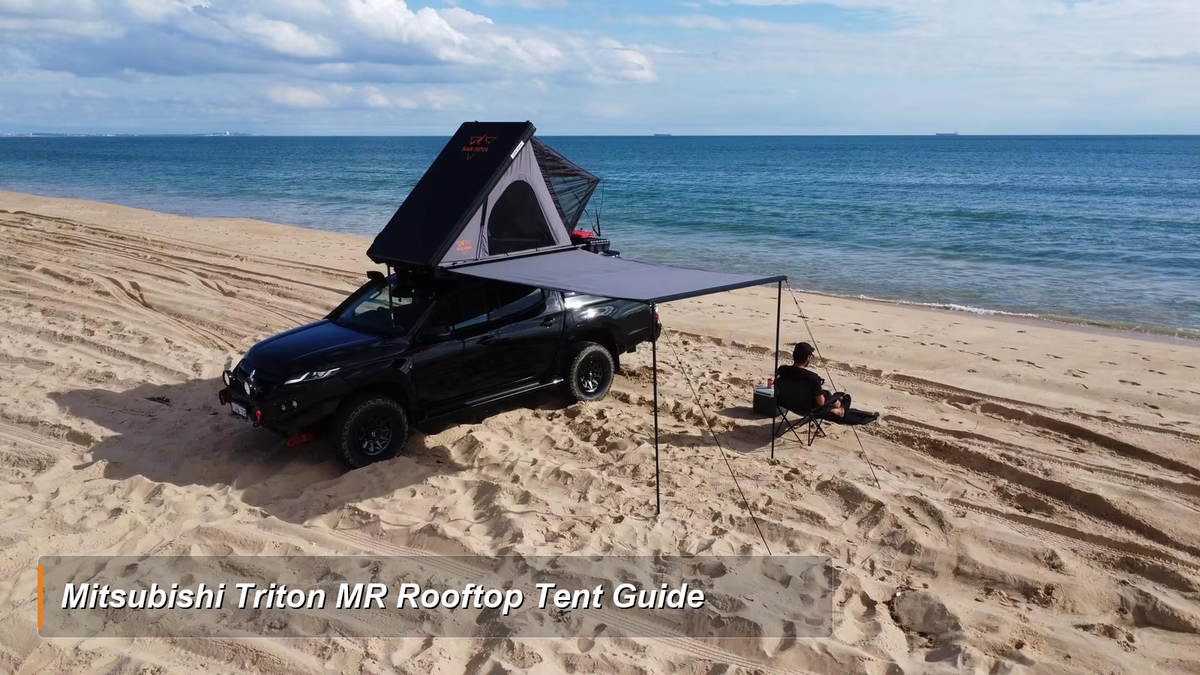
- 4WD Beach & High Country Adventures: Elevated sleeping platform keeps campers away from coastal sand, high tides, and nocturnal wildlife while capturing sea breezes.
- Remote Off-Grid Overlanding: Integrated top crossbars support solar panels to charge auxiliary dual-battery systems, while internal USB/12V sockets power personal electronics.
- Everyday Work Ute + Weekend Adventurer: The 13.8 cm ultra-slim profile allows the D-MAX to clear suburban parking garages and carports during the work week.

Isuzu D-MAX Rooftop Tent Fitment Checklist
- ☐ D-MAX Variant: Exact D-MAX model year, cab style and roof type confirmed
- ☐ Roof Guidance: Vehicle roof-load guidance verified with official Isuzu documentation
- ☐ Rack Rating: Roof-rack or platform model confirmed and engineered for D-MAX
- ☐ Dynamic Load: Dynamic roof load calculated (Tent 73 kg + Rack ~18 kg + Hardware ~3 kg = ~94 kg)
- ☐ Static Load: Static roof load understood for stationary camping
- ☐ Off-Road Factor: Off-road derating factor checked for unsealed tracks
- ☐ Crossbar Spread: Crossbar spread measured between 75 cm and 95 cm
- ☐ Rail Spacing: Kalbarri Gen 2 74.5 cm rail spacing aligned with crossbar channels
- ☐ Hardware Clearance: Mounting hardware confirmed with safe roof clearance
- ☐ Ladder Geometry: Ladder clearance and 70–75° ground angle verified
- ☐ Surrounding Clearance: Rear tailgate, aerial, awning and canopy window clearances checked
- ☐ Total Height: Completed overall vehicle height measured and noted
- ☐ Payload & GVM: Total vehicle payload and GVM verified with occupants and touring gear
- ☐ Re-Torque Schedule: Mounting hardware rechecked after 50 km and scheduled for regular trail inspections
Frequently Asked Questions
Can you put a rooftop tent on an Isuzu D-MAX?
Yes, an Isuzu D-MAX can be fitted with a rooftop tent when the specific vehicle variant, roof rack or mounting structure, mounting hardware and tent meet all applicable load and dimensional requirements. Compatibility depends on the cab style, mounting position (cabin roof, tub rack or canopy), complete dynamic load and intended driving conditions.
What rooftop tent fits an Isuzu D-MAX?
The most suitable rooftop tent for an Isuzu D-MAX is one whose dry weight, folded dimensions, mounting-rail spacing and mounting hardware align with the D-MAX’s vehicle roof or canopy rack specifications. Hard-shell tents measuring approximately 2.0 to 2.15 metres in length and weighing under 75–80 kg generally offer the best balance of fitment, aerodynamics and stability.
Is the SAN HIMA Kalbarri Gen 2 suitable for an Isuzu D-MAX?
The SAN HIMA Kalbarri Gen 2 is a strong candidate for an Isuzu D-MAX when paired with a quality, load-rated aftermarket roof rack, platform, tub rack or canopy frame. Its 73 kg base weight (without ladder), 74.5 cm mounting-rail spacing and ultra-slim 13.8 cm folded profile integrate well with D-MAX touring setups.
How much does the SAN HIMA Kalbarri Gen 2 weigh?
The SAN HIMA Kalbarri Gen 2 weighs 73 kg with the telescopic ladder removed, and 78.5 kg with the ladder attached. When calculating total dynamic roof load, always add the weight of your roof rack (typically 12–25 kg) and mounting brackets (2–5 kg).
How tall is the Kalbarri Gen 2 when folded?
The SAN HIMA Kalbarri Gen 2 measures just 13.8 cm (138 mm) in height when folded and latched closed. This ultra-low profile significantly reduces aerodynamic drag on the highway and makes underground garage clearance much easier to manage.
What roof rack do I need for a D-MAX rooftop tent?
You need a heavy-duty aftermarket roof rack, crossbar system, or platform specifically engineered for your Isuzu D-MAX model year and cab style, with an approved dynamic load rating sufficient for the tent and hardware. Look for reputable Australian systems from brands like Rhino-Rack, Yakima, ARB (BASE Rack), or Rola.
What should I check before installing an RTT on a D-MAX?
Check your D-MAX model year and cab style, vehicle handbook roof load limits, roof rack dynamic and static load ratings, crossbar spread, RTT mounting rail spacing (74.5 cm for Kalbarri Gen 2), ladder length and ground angle, and final overall vehicle height.
What is dynamic roof load?
Dynamic roof load is the total weight the vehicle roof and rack system can safely carry while the vehicle is driving in motion. It includes the rooftop tent, ladder, rack, crossbars, mounting hardware and any accessories attached to the roof.
What is static roof load?
Static roof load is the structural load supported while the vehicle is completely stationary at camp. It accounts for the deployed tent, rack, internal bedding and sleeping occupants. Static capacity is substantially higher than dynamic capacity but cannot be used as a driving limit.
Is a hard-shell rooftop tent practical for an Isuzu D-MAX?
Yes, a hard-shell rooftop tent is highly practical for an Isuzu D-MAX because it offers rapid 30-second setup, robust weather and branch protection, and a low-profile aerodynamic shape that minimises wind noise and fuel consumption.
How much sleeping space does the Kalbarri Gen 2 have?
The Kalbarri Gen 2 provides an internal sleeping area measuring 200 cm (L) × 131 cm (W) × 148 cm (H), accompanied by a 199 × 130 × 5 cm high-density memory foam mattress. This comfortably sleeps two adults or a couple with a small child.
What is the mounting-rail spacing on the Kalbarri Gen 2?
The mounting-rail spacing on the underside of the SAN HIMA Kalbarri Gen 2 is 74.5 cm. Crossbars or platform support planks must be wide enough to support this rail width securely.
Conclusion
Installing a rooftop tent on an Isuzu D-MAX transforms an already capable Australian 4WD ute into an exceptional, go-anywhere touring and overlanding machine. However, successful fitment requires viewing the installation as a complete, interdependent engineering system rather than simply buying a tent off the shelf.
The SAN HIMA Kalbarri Gen 2 Hard Shell Rooftop Tent stands out as an outstanding, Australian-ready option for D-MAX owners to evaluate. With its 73 kg base weight, ultra-slim 13.8 cm closed profile, robust aluminium honeycomb base, rapid gas-strut deployment, and weather-tested PU 5,000 mm / UPF 50+ materials, it delivers the ideal blend of rugged off-road durability, touring comfort, and everyday vehicle practicality.
When matched to an appropriately configured D-MAX and verified against manufacturer guidelines, this setup provides a reliable, comfortable home on wheels for exploring Australia's vast highways, coastal beaches, and rugged outback tracks.

Leave a comment
This site is protected by hCaptcha and the hCaptcha Privacy Policy and Terms of Service apply.