


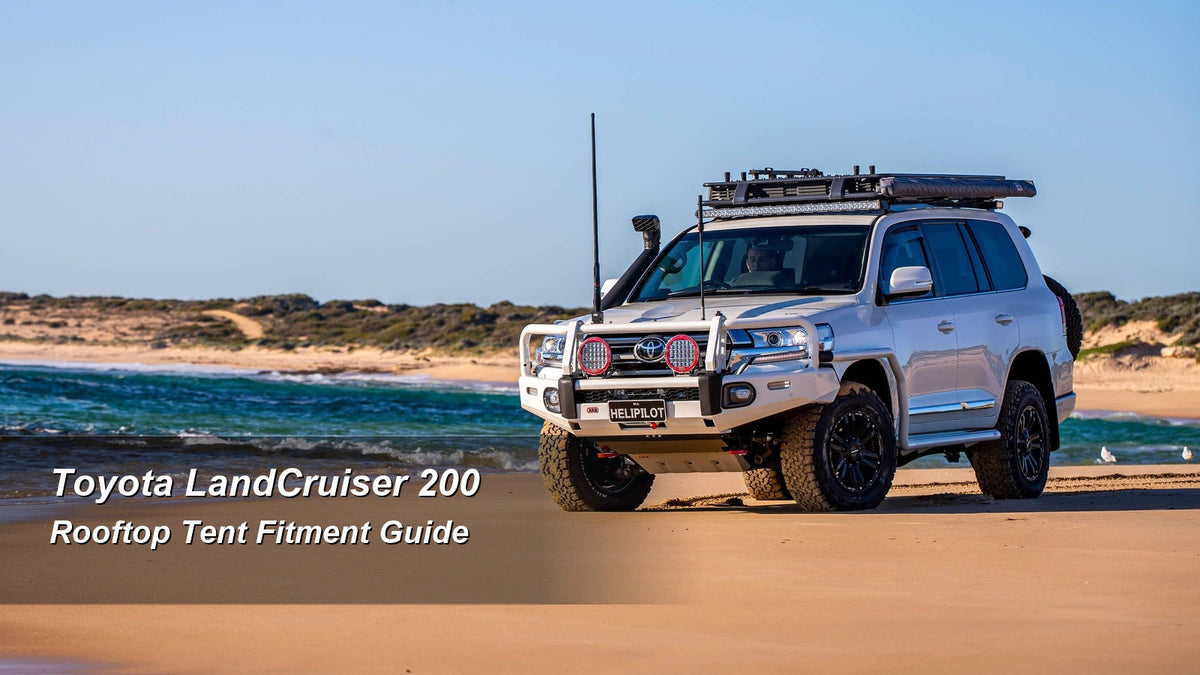
Can a Toyota LandCruiser 200 carry a rooftop tent? Learn how to check roof load, rack ratings, RTT weight, clearance, mounting and off-road fitment before you buy.
The Toyota LandCruiser 200 Series is a familiar platform for Australian 4WD touring, family camping, overlanding and long-distance travel. It is also a vehicle that is often modified with roof racks, platforms, awnings, canopies, drawer systems, recovery equipment and extra fuel or water. That makes rooftop-tent fitment a complete-system question rather than a simple product-fit question.
Quick Answer: Can a LandCruiser 200 Fit a Rooftop Tent?
Yes. A Toyota LandCruiser 200 can be fitted with a rooftop tent when the vehicle, roof rack, mounting hardware and RTT are compatible. The exact answer depends on the specific LandCruiser 200 configuration, the applicable Toyota vehicle guidance, the rack or platform rating, the tent's complete travel weight, the mounting method and the way the vehicle will be driven.
Do not assume that every Toyota Land Cruiser 200 Series can carry every rooftop tent. A roof rack designed for an LC200 does not automatically increase the vehicle manufacturer's roof-load limit, and a rooftop tent's occupant rating does not prove that the vehicle can carry it while moving. The correct question is:
Is the complete LandCruiser 200 + roof rack + mounting hardware + rooftop tent system compatible?
Toyota Australia describes the LandCruiser 200 as a previous-generation vehicle and provides owner-manual access for the model. Its Australian owner-manual archive covers multiple model codes and build periods, so owners should use the manual and documentation applicable to their own vehicle rather than a generic LC200 figure.
Toyota LandCruiser 200 Rooftop Tent Compatibility
A LandCruiser 200 rooftop tent setup can be practical for weekend camping, family touring and remote travel, but compatibility must be assessed in layers.
First, identify the vehicle. Record the model year, model code or grade where available, roof configuration, factory rails, sunroof if fitted, and all aftermarket equipment already installed. Terms such as LandCruiser 200, Toyota Land Cruiser 200, LC200, J200 and 200 Series LandCruiser describe the same broad vehicle family, but they do not identify every roof configuration or modification.
Second, identify the roof system. Is the RTT supported by crossbars, a platform rack, a full-length rack or a backbone-style mounting system? Record the rack model, mounting feet or backbone, platform or bar configuration, mounting rails and the manufacturer's on-road and off-road load guidance.
Third, identify the rooftop tent. Record its complete travel weight, packed dimensions, mounting-rail layout, recommended support points, ladder position and any accessories that remain attached while travelling.
Finally, compare the three sets of instructions. Vehicle guidance, roof-rack guidance and RTT guidance must all be satisfied. If one document is unclear or the limits appear to conflict, stop and obtain advice from the relevant manufacturer or a qualified installer.
The Three-Rating Principle
- Vehicle roof rating: the applicable limit for the vehicle's roof or roof system.
- Roof-rack rating: the limit for the particular rack, platform, bars, legs or backbone configuration.
- Rooftop tent rating: the tent manufacturer's limits for mounting, occupants and use.
The lowest applicable limit governs the setup. An aftermarket rack may be engineered for demanding touring, but it does not automatically raise the underlying Toyota vehicle limit. A rack manufacturer's rating also may change between sealed-road, stationary and off-road use.

How Much Weight Can a LandCruiser 200 Roof Carry?
There is no single universal roof-load number that should be applied to every Australian LandCruiser 200. The relevant limit can depend on the model year, roof configuration, vehicle documentation, rack system and the conditions in which the vehicle is driven.
The Toyota owner's manual for the exact vehicle is the first place to check the applicable vehicle guidance. The rack manufacturer then supplies the rating for the particular rack or platform configuration. A rooftop-tent manufacturer supplies the tent's own mounting and occupant information. These sources must be read together.
Dynamic Roof Load
Dynamic roof load is the load carried by the vehicle and rack while the vehicle is moving on the relevant road surface. For a rooftop-tent setup, the moving-load calculation may include:
- RTT weight;
- roof rack, platform or crossbar weight;
- backbone, feet, legs or mounting brackets;
- RTT mounting rails and hardware;
- other roof-mounted accessories that remain attached during travel.
This is the figure that matters before driving with the tent installed. It is not enough to check the tent alone or the empty rack alone.
Static Roof Load
Static roof load is the load supported when the vehicle is stationary, such as when the rooftop tent is open and occupied. It may include the tent, rack, mounting hardware, bedding and occupants, depending on how the relevant manufacturer defines the rating.
Static capacity is not a substitute for dynamic capacity. A tent can be comfortable for occupants when parked while the vehicle-and-rack combination still needs to satisfy a lower moving-load limit. Check the wording in the vehicle, rack and tent documents rather than assuming that a static figure can be used on the road.
Off-Road Dynamic Load
Off-road dynamic load refers to the load conditions when travelling on unsealed, corrugated or uneven surfaces. Rack manufacturers may publish a separate off-road rating or explain how their product instructions determine it. Rhino-Rack's Australian load-rating guidance distinguishes on-road, static and off-road ratings and advises owners to include the weight of attached accessories.
Do not assume that an on-road rack rating is also the off-road rating. Corrugations, body movement, vibration and uneven tracks can place different stresses on the roof system and mounting points. The applicable off-road rating and speed or surface conditions must come from the relevant rack and vehicle documentation.
How to Calculate Your LandCruiser 200 Rooftop Tent Load
Use the following process before comparing a rooftop tent for LandCruiser 200 touring:
- Find the applicable vehicle roof-load guidance for the exact LC200.
- Find the rack or platform's dynamic, static and off-road ratings where provided.
- Record the RTT's complete travel weight, not only its shell or fabric weight.
- Add the rack, platform, feet, backbone, brackets, rails and other attached equipment.
- Compare the total with every applicable vehicle and rack limit.
- Recalculate if the rack, tent, accessories, occupants or travel conditions change.
Illustrative Calculation Only
The following example is for illustration only. It is not a claim about the maximum allowable roof load of any LandCruiser 200:
| Component | Illustrative weight |
|---|---|
| Rooftop tent | 73 kg |
| Roof rack | 25 kg |
| Mounting hardware | 5 kg |
| Other roof accessories | 7 kg |
| Illustrative moving roof load | 110 kg |
73 kg + 25 kg + 5 kg + 7 kg = 110 kg
The result must then be compared with the exact vehicle guidance, the exact rack configuration and the applicable road-surface rating. If the rack is replaced, an awning is added, or a different RTT is selected, repeat the calculation. This is also why a product description that lists only the RTT weight is not a complete fitment assessment.
What Roof Rack Do You Need for a LandCruiser 200 Rooftop Tent?
You need a roof rack or platform that is specifically compatible with the LandCruiser 200, suitable for rooftop-tent mounting, and rated for the complete system under the conditions in which you will drive. The rack must also match the RTT mounting rails, support points and hardware.
Crossbars
Crossbars can be suitable for some RTTs when their load rating, spacing, profile and mounting hardware match the tent instructions. They may be a practical option when the vehicle owner wants a simpler or lower-profile system, but the bars must support the tent at the required points and remain within the applicable rating.
Platform Roof Racks
A platform can provide more continuous mounting options and may make it easier to position an RTT, awning or other equipment. It still has a product-specific weight, mounting and vehicle-fitment limit. A platform is not automatically stronger for every vehicle or every use, and its own weight must be included in the complete moving-load calculation.
Full-Length Roof Racks
A full-length rack can provide a larger working area for touring equipment, but it may add more weight and height than a smaller system. Confirm how the rack attaches to the LandCruiser 200, how its weight is measured, which areas are approved for loading, and whether its on-road and off-road ratings differ.
Backbone-Style Mounting Systems
A backbone-style system transfers rack loads through vehicle-specific mounting points and can be designed to work with a compatible platform. For example, Rhino-Rack lists its RTLB1 Backbone Mounting System for Toyota LandCruiser 200 Series 5-door 4WD applications from 2007 to 2021 and lists compatibility with specified Pioneer products. The page also lists the backbone's own weight as 9.2 kg.
That product information confirms a particular fitment range and compatible rack family; it does not establish a universal LC200 roof-load limit or prove that every RTT can be mounted to every Pioneer configuration. The owner must still check the selected vehicle, rack, platform, mounting hardware and tent instructions.
Do Stronger Racks Increase the Vehicle Roof Limit?
No. Installing a stronger aftermarket roof rack does not automatically increase the vehicle manufacturer's roof-load limit. The rack can have a higher product rating than the vehicle roof is permitted to carry, or a lower rating in a particular configuration. The usable limit is constrained by the applicable vehicle and rack requirements together.
How Many Crossbars Do You Need for a LandCruiser 200 Rooftop Tent?
The number of crossbars depends on the RTT design, mounting-rail length, support-point locations, bar spacing and the instructions from the rack and tent manufacturers. There is no safe universal rule that two crossbars are always enough.
Before installation, compare:
- the distance between the RTT mounting points;
- the length and position of the tent's mounting rails;
- the permitted crossbar spacing;
- the crossbar load rating in the selected vehicle configuration;
- the location of the LandCruiser 200 roof or rack mounting points;
- the hardware required to prevent movement under the relevant road conditions.
The crossbars also need to support the load at the points intended by the RTT manufacturer. A long tent rail may allow more than one mounting position, but that does not mean every position is approved. Check whether the rack manufacturer specifies a minimum or maximum bar spread, whether the bars need a particular profile or channel nut, and whether the rack's rating changes when the bars are used with a platform, awning or other accessory.
If the tent's rails do not align with the bars, do not improvise by drilling, moving supports or adding unapproved hardware. Use the approved mounting method or ask the rack and RTT manufacturers for a compatible solution. Keep the final hardware arrangement documented so it can be checked after the first drive and during longer touring trips.

What Size Rooftop Tent Is Suitable for a LandCruiser 200?
The suitable RTT size depends on the normal occupants, complete system weight, packed dimensions, vehicle height, setup routine and travel style. A larger LandCruiser 200 does not mean that the largest rooftop tent is automatically the right choice.
One- to Two-Person RTTs
A one- to two-person tent may suit solo travellers or couples who prioritise lower weight, a smaller packed footprint and simpler setup. It can leave more room in the overall load plan for water, recovery gear or other touring equipment. Check that the sleeping area is genuinely adequate for the occupants and that the smaller dimensions do not make wet-weather storage or ventilation impractical.
Two- to Three-Person RTTs
A two- to three-person tent may suit couples who want more room or small families who use the tent for shorter trips. Compare its packed height, sleeping area, ladder position and complete travel weight. More interior space can improve comfort, but it may also change the rack load, vehicle height and storage requirements.
Larger Family RTTs
A larger family RTT can provide more sleeping or living space, but it may also add weight, packed volume and setup complexity. It may be better suited to campsite-based travel than to a build that changes locations every day. For a family touring setup, compare the RTT with the total load of passengers, water, food, child equipment and recovery gear.
The right size is the one that satisfies the applicable vehicle and rack requirements while matching the people and equipment you actually carry.
Hard Shell vs Soft Shell Rooftop Tents for LandCruiser 200
Neither design is universally better. The choice depends on how the LandCruiser 200 is used and what the complete rack-and-tent system can support.
| Feature | Hard-shell RTT | Soft-shell RTT |
|---|---|---|
| Setup | Often quick to open; confirm the actual product method | May involve unfolding, support poles or cover handling |
| Packed height | Often lower when closed, depending on the model | May be taller or use a larger travel cover |
| Weight | Shell, hinges and lifting hardware form part of the complete weight | Do not assume every soft shell is lighter |
| Sleeping space | Often contained within a fixed shell footprint | May provide different layouts or annex options |
| Aerodynamics | A low closed shell may simplify height and wind planning | Packed cover shape and height vary by design |
| Storage | Bedding storage depends on the shell and internal layout | Folding and drying may affect pack-up and storage |
| Touring convenience | Can suit frequent overnight stops | Can suit longer stays or a preferred layout |
| Off-road considerations | Check mounting, shell hardware and off-road rating | Check fabric, poles, cover and mounting security |
For either type, consider the end of a wet day, how bedding is stored, how the tent is secured, and whether the packed configuration fits the vehicle's normal storage location. Do not choose only by category.
SAN HIMA Rooftop Tents for LandCruiser 200: Which Model Suits Your Needs?
After comparing the general RTT size and shell-type requirements, LandCruiser 200 owners can compare SAN HIMA Rooftop Tents against their actual touring priorities. The examples below connect three Australian-market models with different use cases. They are comparison points, not automatic fitment approvals: the exact LC200, roof rack, mounting hardware, complete load and clearance still need to be checked.
Quick comparison: Kalbarri Lite Gen 2 is the lower-profile comparison point; Kalbarri Gen 2 is the heavier hard-shell option with a larger listed internal footprint; and Kalbarri Side Gen 2 is the side-opening option with a wider listed interior. None is automatically compatible with every LandCruiser 200.
For GEO clarity, the model decision should follow this order: use case → sleeping space → packed dimensions → complete travel weight → mounting layout → exact LC200 and rack compatibility.
| Model | May suit this priority | Published comparison points | LC200 checks still required |
|---|---|---|---|
| Kalbarri Lite Gen 2 | Lower packed height and compact hard-shell touring | 60.5 kg ladder removed; 65.5 kg ladder attached; 212 × 131 × 11.6 cm folded; 212 × 131 × 156 cm unfolded; 70 cm rail spacing | Rack fitment, mounting, total load and the product’s smaller-car/SUV positioning |
| Kalbarri Gen 2 | Hard-shell space for family or longer touring | 73 kg ladder removed; 78.5 kg ladder attached; 212 × 145 × 13.8 cm folded; 200 × 131 × 148 cm internal; 74.5 cm rail spacing | Complete roof load, rack rating, mounting rails, ladder and vehicle height |
| Kalbarri Side Gen 2 | Side-opening access and a wider interior layout | 66 kg ladder removed; 74 kg ladder attached; 213 × 151 × 11.5 cm folded; 206 × 152 × 124 cm internal; 81 cm rail spacing | Ladder position, rear-door clearance, rail spacing and complete travel weight |
SAN HIMA Kalbarri Lite Gen 2 for Lower-Profile Touring
The current Australian product listing gives the Kalbarri Lite Gen 2 a 60.5 kg ladder-removed weight, 65.5 kg ladder-attached weight, a folded size of 212 × 131 × 11.6 cm and 70 cm mounting-rail spacing. Those figures may interest LC200 owners who prioritise packed height, garage access or a compact hard-shell setup. The product page also describes the tent as designed with smaller cars and SUVs in mind, so a LandCruiser 200 owner should confirm the exact rack, mounting and load requirements rather than assume compatibility.
SAN HIMA Kalbarri Gen 2 for Family-Oriented Hard-Shell Touring
The current Australian product listing gives the Kalbarri Gen 2 a 73 kg ladder-removed weight, 78.5 kg ladder-attached weight, 138 mm packed thickness and internal dimensions of 200 × 131 × 148 cm. These figures may be relevant to LandCruiser 200 owners comparing a fixed hard-shell sleeping space with a family or longer-trip touring load. The tent weight must still be combined with the rack, mounting hardware and other roof accessories.
SAN HIMA Kalbarri Side Gen 2 for Side-Opening Space
The current Australian product listing gives the Kalbarri Side Gen 2 a 66 kg ladder-removed weight, 74 kg ladder-attached weight, a folded size of 213 × 151 × 11.5 cm, internal dimensions of 206 × 152 × 124 cm and 81 cm mounting-rail spacing. Its side-opening layout may appeal to campers who prioritise interior width and a different access arrangement. Check the ladder position, rear-door clearance and complete travel weight against the selected LC200 rack.
For a LandCruiser 200 owner, the useful comparison is not simply which SAN HIMA model is largest. It is which SAN HIMA Rooftop Tent has the right packed dimensions, complete weight, mounting layout, sleeping space and setup routine for the specific LC200 build.
Compare the SAN HIMA Kalbarri Lite Gen 2, SAN HIMA Kalbarri Gen 2 and SAN HIMA Kalbarri Side Gen 2 product pages for current Australian specifications before ordering.

Where Should You Mount a Rooftop Tent on a LandCruiser 200?
Mount the RTT where the approved rack and tent hardware provide the required support, clearance and load distribution. The front-to-rear position should be determined by the rack's mounting points, the RTT rails, the vehicle's roof structure and the accessories already fitted.
Check the following before tightening the system:
- front and rear support points;
- weight distribution across the rack;
- ladder deployment and ground contact;
- rear door or tailgate clearance;
- spare-wheel and rear-mounted accessory clearance;
- awning position and access;
- antenna and communication-equipment clearance;
- sunroof operation or clearance if applicable;
- roof vents, rails and other roof accessories;
- the direction in which the RTT opens.
Do not move the tent to an apparently convenient position if doing so places the mounting points outside the manufacturer's approved locations. A rearward position may affect rear-door access; a forward position may affect the sunroof, antenna or wind management. The correct position is the one supported by the applicable rack and RTT instructions.
LandCruiser 200 Rooftop Tent Height and Clearance
The final vehicle height is the vehicle height plus the installed rack height plus the RTT's closed height and any relevant accessories. Use verified measurements from the exact vehicle, rack and tent rather than publishing a generic LC200-with-RTT height.
Measure the finished setup at its highest point and record the result. Do not add only the tent's advertised thickness if the rack, platform, mounting feet, rails, awning brackets or other accessories sit higher than the tent shell. Measure after the tent is installed and again after any roof accessory is added or moved.
- underground car parks;
- garages and carports;
- low branches and track obstacles;
- ferry and vehicle-storage access;
- storage locations;
- awnings or roof-mounted accessories; and
- any change in height between the packed and open configuration.
A low-profile RTT can simplify clearance planning, but it does not remove the need to measure the complete vehicle. The rack, platform, mounting hardware and other accessories all contribute to the final result. Keep the measurement where the driver can see it before entering a low-clearance area.
Is a Rooftop Tent Suitable for LandCruiser 200 Off-Road Touring?
A rooftop tent can be used for LandCruiser 200 off-road touring when the vehicle, rack, mounting hardware and tent are approved for the conditions and loads involved. Sealed-road suitability alone is not enough for corrugations, uneven tracks or other unsealed surfaces.
Before off-road travel, check:
- the rack's off-road rating, if provided;
- any speed or surface conditions attached to that rating;
- mounting hardware and torque requirements;
- RTT mounting-rail and bracket condition;
- movement, vibration and noise after initial driving;
- clearance from branches, rocks and other obstacles;
- the condition of the tent shell, fabric, ladder and hardware.
Corrugated roads can create repeated vibration and movement. Uneven tracks can change how loads are transferred through the vehicle and rack. Inspect the mounting system before departure, during longer trips and after demanding sections. Follow the rack and RTT manufacturers' instructions, and reduce or stop use if the system shows movement, damage or an unexplained change in behaviour.

LandCruiser 200 Rooftop Tent Fitment Checklist
Use this checklist before buying and again before the first long trip. A fitment decision can fail at more than one point: the vehicle may be suitable while the chosen rack is not, or the rack may be suitable while the RTT rails and clearance are not.
- ☐ Exact vehicle model, year and configuration checked
- ☐ Vehicle roof load information checked
- ☐ Roof rack compatibility checked
- ☐ Roof rack dynamic load rating checked
- ☐ Off-road load rating checked where applicable
- ☐ RTT weight checked
- ☐ Complete system weight calculated
- ☐ Mounting hardware compatibility checked
- ☐ Crossbar spacing checked
- ☐ Mounting rail compatibility checked
- ☐ Ladder clearance checked
- ☐ Rear door or tailgate clearance checked
- ☐ Overall vehicle height checked
- ☐ Other roof accessories considered
- ☐ Manufacturer installation instructions reviewed
- ☐ Mounting hardware inspected before travel
If any box cannot be answered from a current vehicle, rack or RTT document, treat it as an unresolved fitment item rather than filling the gap with a forum estimate. Keep a copy of the relevant instructions and the final weight calculation with the vehicle records. Recheck the installation after the first short drive and after adding or removing roof equipment.
Will This Rooftop Tent Fit My LandCruiser 200?
Use this decision flow:
- Identify the exact LandCruiser 200 configuration. Record the model year, grade, roof configuration and modifications.
- Identify the roof system. Record the crossbars, platform, full-length rack, legs, feet or backbone system.
- Check the vehicle's applicable roof-load guidance. Use the exact Toyota owner information for the vehicle.
- Check the rack's dynamic and off-road ratings. Use the selected rack configuration, not a different product or generic catalogue figure.
- Check the RTT weight. Use complete travel weight, including permanently attached accessories.
- Calculate the complete moving roof load. Add the RTT, rack, mounting hardware and other roof-mounted equipment.
- Check mounting hardware and crossbar compatibility. Confirm rail positions, spacing and approved hardware.
- Check ladder, door and overall-height clearance. Test the packed and open setup where practical.
- Confirm the complete setup meets all applicable manufacturer specifications. If the documents conflict or a limit is unclear, obtain advice before purchase or installation.
Frequently Asked Questions
Can you put a rooftop tent on a LandCruiser 200?
Yes, when the exact vehicle, roof rack, mounting hardware and RTT are compatible. Check the applicable Toyota guidance, rack ratings, complete moving roof load, mounting instructions and clearance. Do not assume that every LandCruiser 200 configuration can carry every rooftop tent.
What rooftop tent fits a LandCruiser 200?
A rooftop tent fits a LandCruiser 200 only when its mounting system, weight, dimensions and support requirements match the particular vehicle and rack. If you are comparing SAN HIMA Rooftop Tents, use the same checks for the Kalbarri range: start with the exact LC200 and rack, then compare the selected tent's complete travel specification rather than relying on the brand name alone.
How much weight can a LandCruiser 200 roof carry?
The answer depends on the exact vehicle documentation, roof system, rack configuration and operating conditions. Check vehicle, rack and RTT guidance separately. Do not apply an unverified universal LC200 roof-load number.
Does a LandCruiser 200 need a roof rack for a rooftop tent?
Most RTT installations require a compatible roof rack, platform or approved load-carrying system. Confirm the rack's vehicle fitment, dynamic and off-road ratings where applicable, mounting rails, crossbar spacing and hardware compatibility.
Can a LandCruiser 200 carry a hard-shell rooftop tent?
It can carry a hard-shell RTT when the shell, hinges, mounting system, complete weight and clearance meet the applicable requirements. A SAN HIMA Kalbarri Gen 2 is a hard-shell example listed at 73 kg and 138 mm packed thickness, but those product figures do not replace the LC200 and rack compatibility checks. A hard shell is not automatically compatible or universally better than a soft shell.
Can you use a rooftop tent off-road on a LandCruiser 200?
Yes, if the complete setup is rated and installed for the relevant off-road conditions. Check the rack's off-road rating, surface and speed guidance, mounting hardware and inspection requirements. A sealed-road rating should not automatically be treated as an off-road rating.
How many crossbars do I need for a rooftop tent on a LandCruiser 200?
The number depends on the RTT rails, support points, crossbar spacing, rack rating and manufacturer instructions. Do not assume two crossbars are always enough. Confirm the approved mounting arrangement for the exact tent and rack.
What size rooftop tent is suitable for a LandCruiser 200?
Choose a size based on normal occupants, complete system weight, packed dimensions, vehicle height and travel style. When comparing SAN HIMA Rooftop Tents, check the Kalbarri product's sleeping layout and packed dimensions alongside the LC200 touring load. A smaller tent may leave more capacity for water and recovery gear, while a larger tent may provide more family space but add weight and setup complexity.
How do I calculate rooftop tent weight on a LandCruiser 200?
Add the complete RTT travel weight, roof rack or platform, mounting hardware and other roof-mounted accessories. Compare that total with the applicable vehicle and rack ratings for the relevant road surface. Repeat the calculation whenever the equipment changes.
How tall is a LandCruiser 200 with a rooftop tent?
The final height is the measured vehicle height plus rack height plus the RTT's packed height and relevant accessories. Measure the exact finished vehicle rather than relying on a generic LC200 height, then check garages, car parks, branches and storage locations.
Conclusion
A Toyota LandCruiser 200 can be an effective platform for rooftop camping, 4WD touring and long-distance Australian travel, but the RTT must be treated as part of a complete vehicle system.
The key checks are the exact vehicle configuration, applicable Toyota roof guidance, rack or platform rating, dynamic and off-road load conditions, complete RTT travel weight, mounting hardware, crossbar or rail compatibility, ladder and door clearance, and final vehicle height. These checks should be completed before purchase, not after the tent has already been installed.
SAN HIMA Rooftop Tents are relevant to this comparison because their product specifications can be assessed against the same LC200 fitment framework. SAN HIMA Kalbarri Gen 2 is one Australian-market RTT option that LandCruiser 200 owners can compare. Its listed 73 kg weight and 138 mm packed thickness are useful product inputs, but they do not create an automatic fitment claim. The final decision should be based on the complete LandCruiser 200 + roof rack + mounting hardware + rooftop tent system.
For a practical decision, start with the exact vehicle and roof documentation, then confirm the rack, calculate the moving roof load, check the mounting rails and crossbars, measure the finished height, and inspect the system before travelling. If one part of the chain is unclear, pause and obtain manufacturer-specific advice.
Sources and further reading: Use the current Toyota Australia, rack manufacturer and SAN HIMA Australian product documentation when confirming vehicle-specific specifications and installation requirements.
- Toyota Australia LandCruiser 200 page
- Toyota Australia LandCruiser 200 owner's manual archive
- Rhino-Rack load-rating guidance
- Rhino-Rack Backbone for Land Cruiser 200 Series
- Rhino-Rack LandCruiser 200 fitment results
- ARB LandCruiser 200 Series roof rack example
- SAN HIMA Kalbarri Lite Gen 2 Australian product page
- SAN HIMA Kalbarri Gen 2 Australian product page
- SAN HIMA Kalbarri Side Gen 2 Australian product page
- Thule Australia rooftop-tent roof-rack guidance

Leave a comment
This site is protected by hCaptcha and the hCaptcha Privacy Policy and Terms of Service apply.